
Keine weiteren Bilder verfügbar
The Oberkassel Bridge is the oldest Rhine bridge in Düsseldorf for private vehicles. After the Hammer Railway Bridge, it is the second permanent Rhine bridge in Düsseldorf.
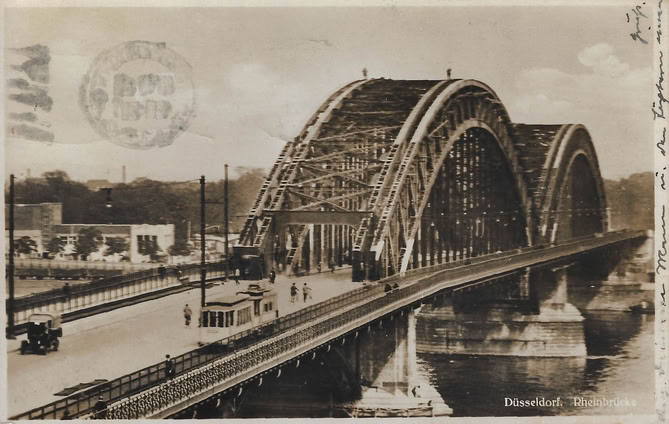
The first Oberkassel Bridge was built between 1896 and 1898 on behalf of the Rhenish Railway Company (Rheinische Bahngesellschaft AG) and on the initiative and through the financing of the Rhine Railway founders Heinrich Lueg, Franz Haniel Jr., Friedrich Vohwinkel, and August Bagel "the Younger" as part of the K-Bahn (K-Bahn) and was opened on November 12, 1898.[7] Its two large iron truss arches, each with a span of approximately 181 meters, and the four shorter arches over the Düsseldorf Rhine shipyard and the flat Oberkassel bank were designed by the engineer Reinhold Krohn and built by the Gutehoffnungshütte steelworks in (Oberhausen-) Sterkrade. The two historicist gate towers and the superstructure of the central pier with the figure of the Bergish Lion facing upstream, as well as the bridge railing, were designed by the Düsseldorf architect and painter Adolf Schill, who had been a professor of decoration and ornamentation at the Düsseldorf Art Academy since 1880.[8] The portals were not only important focal points for Luegallee and the Rhine embankment, which ran roughly parallel to the bridge construction, but also served as collection points for the initially levied bridge toll. All the massive structural components were built by the construction company Philipp Holzmann & Cie. GmbH. The construction costs amounted to approximately six million marks. In order to construct the portal and the bridge approach on the eastern bank of the Rhine, the safety harbor located there was filled in. This was possible because the first facilities of today's port at Lausward were opened on May 30, 1896. The bridge not only improved Rhine shipping by making the existing pontoon bridge on the Old Town bank, which had been an obstacle to navigation, unnecessary. It also improved interregional private transport and the connection to the Heerdt district, which included Oberkassel, and was a significant step towards the later incorporation of these districts into Düsseldorf. In Oberkassel, a construction boom began after the bridge's completion and the opening of the K-Bahn (light rail) running on it. The areas near the riverbank, in particular, became a desirable, centrally located residential area. In 1925/1926, the Oberkassel Bridge was reinforced and widened to accommodate the increased traffic. The tram tracks were separated from the roadway; the tracks were now located on the outer sides of the bridge arches. The gate towers on the outer bridge piers and the Bergish Lion on the central bridge pier were completely removed.[9] The Düsseldorf architect Eduard Lyonel Wehner was involved in this reconstruction.
After 1933, the structure was named the Skagerrak Bridge in commemoration of the Battle of Jutland (Skagerrak) in the First World War. Like all other Rhine bridges in Düsseldorf, the Skagerrak Bridge was blown up by the Wehrmacht on March 3, 1945, to delay the advance of the British and Americans across the Rhine.