Wikipedia:
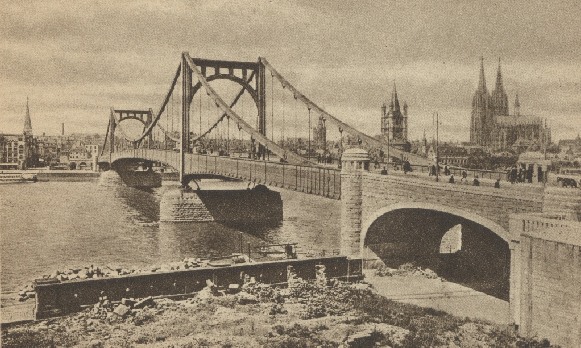
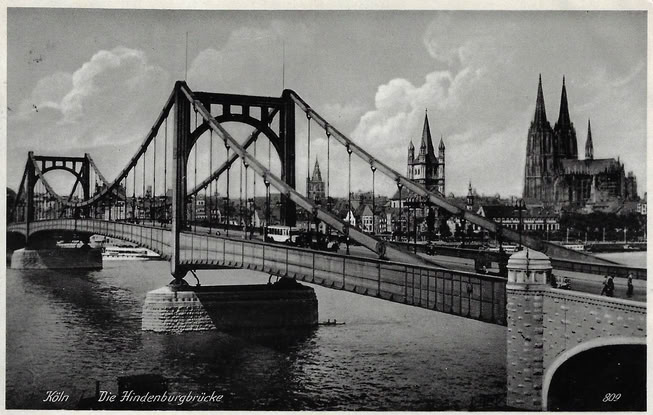
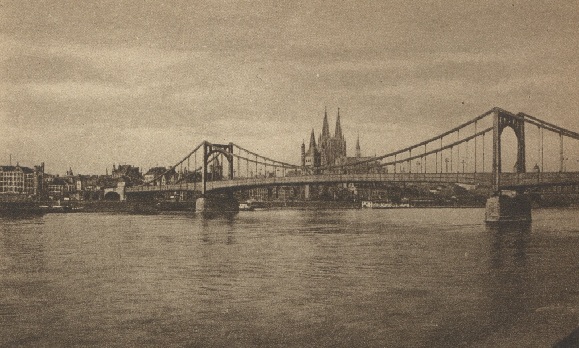
From 1913 to 1915, the "Deutz Suspension Bridge" was built at this location. In 1935, it was renamed the Hindenburg Bridge after Reich President Paul von Hindenburg, who had died the previous year.
A first competition for a fixed road bridge between Cologne and Deutz had been held in 1898 among four construction companies, but it did not produce a result. In 1910, another call for proposals was issued, in which all the major German steel construction companies participated – mostly in cooperation with well-known architects such as Bruno Möhring, Theodor Fischer, Hans Poelzig, or Franz Schwechten – with 29 projects. Since the jury was once again unable to agree on a winning project, a further competition was announced in July 1912 among the authors of the five prize-winning entries. This competition was won by the companies MAN Werk Gustavsburg (steel superstructure) and Grün & Bilfinger (substructures) won the competition with the project Freie Bahn. The architectural design of the massive components (abutments and approach bridge) was the responsibility of the then prominent Cologne architect Carl Moritz.
After the competition decision, the German-Luxembourg Mining and Smelting Company, Dortmund Union Division, and its artistic advisor Peter Behrens alleged that the winning project was largely a plagiarism of their own design Kunst und Technik from the second competition of 1910/11. A subsequent legal battle, involving numerous renowned experts, was fought out before the Cologne Regional Court and received nationwide attention as the “Cologne Bridge Dispute.”[3] The dispute was only resolved in April 1914 through an out-of-court settlement. The structure, built on the basis of the "Freie Bahn" (Free Path) design, was constructed as a self-anchored, stiffened suspension bridge in nickel steel with a structural weight of approximately 6,200 tons and cost over seven million marks. The American engineer Holton D. Robinson is said to have provided consulting services for the design of its pylons and later invited David B. Steinman to join him in founding the engineering firm Robinson & Steinman.[4] The Deutz suspension bridge served as a model in 1924 for the construction of the Three Sisters in Pittsburgh, Pennsylvania,[4] and for the Kiyosu Bridge over the Sumida River in Tokyo.[3] The 18.2 m wide bridge was widened to 27.5 m in 1939/1940 during the construction of the east-west road (today Hahnenstraße/Cäcilienstraße). On February 28, 1945, the Hindenburg Bridge, heavily burdened by refugees and military vehicles, suddenly collapsed during repairs to war damage. The high pressure forces in the roadway girder may have been underestimated. Due to the chaos of war, the number of victims of this daylight disaster could never be determined. An eye bar, one of the supporting chain links of the structure, now stands as a memorial on the northern pedestrian walkway on the left bank of the Rhine. At the end of the war, the McNair Bridge, located next to the destroyed suspension bridge, served as a temporary bridge for the transport of vehicles and pedestrians.

 Use in accordance with the terms and conditions