BAS 164
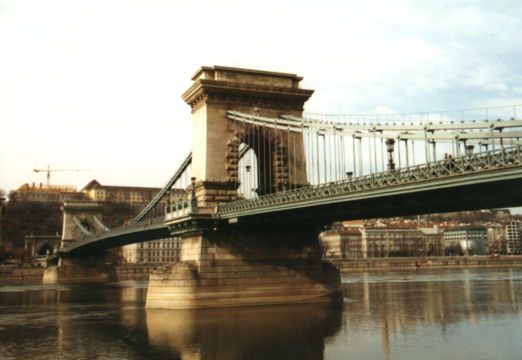
Széchenyi Lánchíd = Chain Bridge
© Frank Sellke / brueckenweb.de
 Use in accordance with the terms and conditions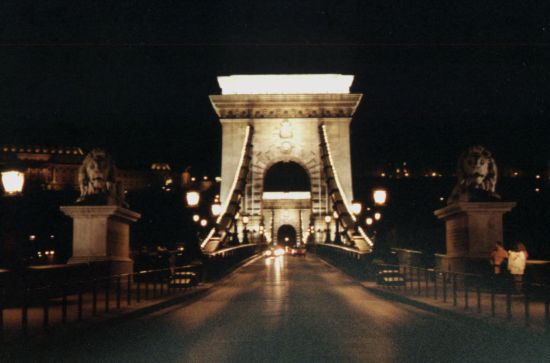
© Frank Sellke / brueckenweb.de
Use in accordance with the terms and conditions
Kettenbrücke, Bl. v. Burgberg - d.h. v. SW
15.8.2016
© Dr. Manfred Böhmer
Use in accordance with the terms and conditionsHungary
Budapest
City center
Duna = Danube
Street
Suspension bridge, chain bridge
Steel
1840 bis 1849
202.00 m
375.00 m
12.50 m
6.50 m
0.00 m
0.00 m2
in operation
The first permanent Danube bridge in Budapest, a landmark of the Hungarian capital, was built between 1840 and 1849 at the instigation of Count István Széchenyi. He was not granted the opportunity to walk across the bridge. In September 1848, Széchenyi collapsed and spent the rest of his life in the Döbling Asylum in Vienna. As early as 1832, Széchenyi had initiated the founding of the Budapest Bridge Society, which was dedicated to compiling all known bridge designs and developing a new design, taking into account various geological studies. The English engineer William Tierney Clark was commissioned with the design, and the construction management was entrusted to his namesake, Adam Clark. On July 28, 1840, preparations began for the first pier, with wooden piles being driven into the riverbank to form a perimeter fence around the construction site. This work lasted two years. On August 24, 1942, the ceremonial laying of the foundation stone in the excavation pit of the Pest abutment took place.
The bridge's 125th anniversary was commemorated in 1998 with the issuance of a coin. Counting backwards, the bridge in its current form would then date from 1873.
Karte wird geladen …