Foundation stone laid: May 20, 1962, Opening on September 3, 1965
br />
Largest bridge in Germany (largest span)
Wikipedia:
The Emmerich Rhine Bridge, at 803 meters, is the longest suspension bridge in Germany and, at 500 meters, has the longest pier of any bridge in Germany. The bridge was designed by civil engineer Hellmut Homberg, with architectural professor Heinrich Bartmann contributing to the design.
The structure spans the Rhine between Kleve and Emmerich at a height of approximately 30 meters at kilometer 853.2. It is the northernmost German Rhine bridge. The road bridge has two driving and emergency lanes as well as two pedestrian walkways and is part of Federal Highway 220. The Minister-President of the State of North Rhine-Westphalia, Franz Meyers, laid the foundation stone on May 2, 1962. The Emmerich Rhine Bridge was opened on September 3, 1965.
As part of the construction tender, Fritz Leonhardt, with advice from Gerd Lohmer, designed a monocable suspension bridge with an aerodynamic roadway deck. Although the novel design was 15% cheaper than the conventional design that was built, it was not implemented because there was no prior experience with it.[3]Construction
Construction
Hoverbridge
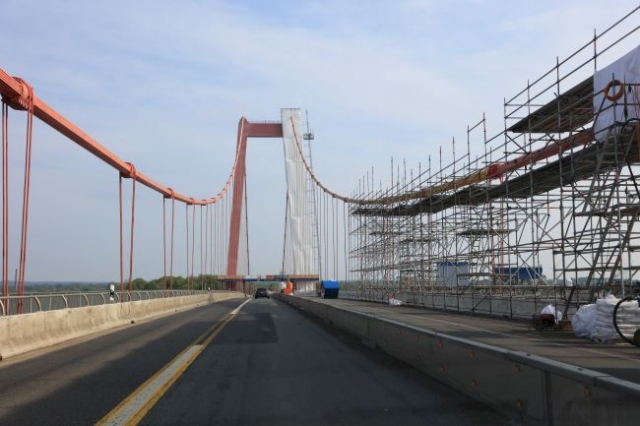
The actual suspension bridge, including its two anchorage blocks, has a length of 893 m. It has spans of 151.5 m in the end spans and 500.0 m in the main span. The structure has two 76.7 m high steel pylons. The pylon stems are inclined at the top by 5.8 m towards the bridge axis and connected by a 5.5 m high crossbeam. The trapezoidal stem cross-section has external dimensions of 4.0 m in the longitudinal direction and 3.25 m in the transverse direction at the river piers, and 2.5 m and 3.25 m at the pylon head.
Two suspension cables, each consisting of 61 individual ropes with an external diameter of 45 cm, are run over the pylons at a distance of 16.8 m. The cable sag between the pylon and the center of the bridge is 55.56 m. Suspension cables are attached to the main cables at intervals of 15.15 m. These cables support the 4.5 m high steel bridge superstructure. The superstructure consists of two longitudinal stiffening girders, designed as 70 cm wide, postless truss girders. Crossbeams, which support the bridge deck, span between the top chords of the truss girders at intervals of 2.53 m. This is a 22.5 m wide orthotropic slab that cantilevers 2.5 m beyond the main girders on both sides. In the central span, the bridge also has a wind bracing system on its underside to ensure sufficient stability.
h4>Farm Bridge
A 37.5 m long anchorage pier lies between the river bridge and the farm bridge. The farm bridge on the left bank of the Rhine is a five-span, 341 m long prestressed concrete bridge. The spans increase in height, starting at the west abutment, from 59.5 m to 64.5 m, 68.5 m, and 72.5 m, reaching 76.0 m in front of the anchorage pier of the suspension bridge. Correspondingly, the structural height of the beam bridge increases from 3.04 m to 4.19 m. In the transverse direction, the structure has a two-webbed slab girder cross-section with a deck slab that cantilevers 5.25 m on both sides and has a width of 21.6 m.

 Use only on request
 Use in accordance with the terms and conditions
